So What Even Is System Design?
What system design really means, and why writing good code alone isn't enough at scale.
Montu Mia blinked. System design? He knew how to write code, wrangle a database, ship it to a server. What else was there to "design"?
Honestly, you can't blame him. A lot of us assume that writing good code is the whole job. But here's the truth: if writing code is laying bricks, then system design is drawing up the blueprint for the entire building.
Quick example.
Say you open a tiny tea stall on the street corner. You don't need much of a plan. A few planks of wood, a kettle, some cups. You brew the tea yourself, you handle the cash yourself. Two or three customers show up, ten on a busy day. No problem.
Now say you get ambitious: "I'm going to open a hundred branches across the country, like Starbucks or KFC, and serve millions of people a day." Are a few planks of wood going to cut it? Can you run all of that single-handed?
Of course not. Now you have to think about things like:
- How sturdy does the building need to be so it doesn't collapse when thousands of people pour in?
- Where does the kitchen go so food gets out fast?
- Which door do the supplies come through, and where does the trash go out?
- Where are the fire exits?
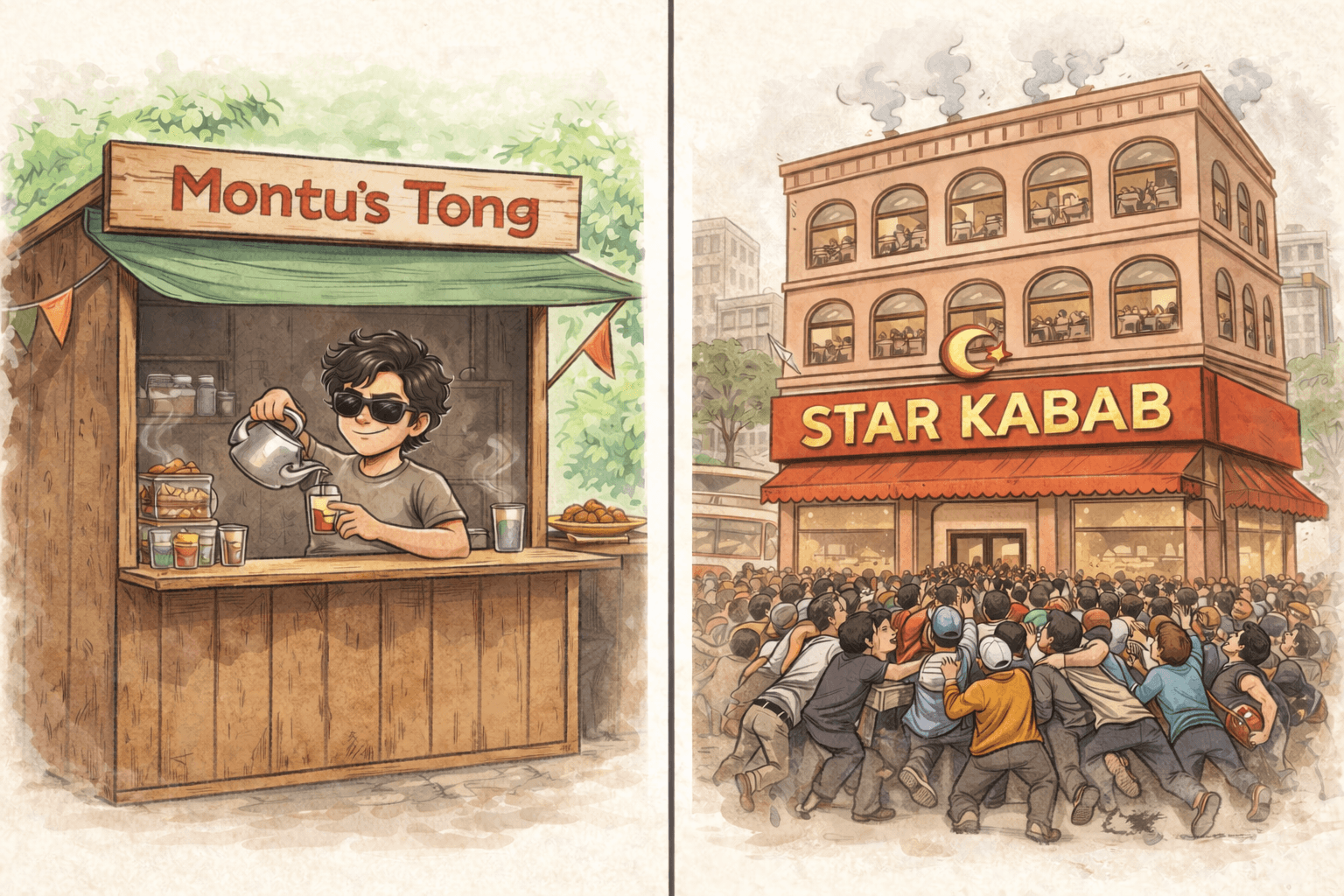
Software works exactly the same way.
System design is this: before you build a system, you plan out its architecture, its modules, how the pieces talk to each other, and how data flows through it. The whole blueprint, drawn up front.
When BiralTube was tiny (the tea stall), one ordinary server and one database handled everything just fine. But the moment millions of users showed up (the packed restaurant), Montu needed a real plan. Which database makes search fast? How do new servers spin up automatically when traffic spikes? How do a viewer in New York and a viewer in Dhaka both get smooth, no-buffering video? Working out answers to questions like these, that is system design.
In one line: system design is the craft that turns ordinary code into a system that's massively scalable and rock-solid reliable.
Montu sat up straight. All this time he'd been laying bricks without ever drawing the blueprint. Time to start thinking like an architect.