How Does a Load Balancer Actually Work?
The algorithms behind load balancing, Round Robin, Least Connections, IP Hash, and more.
So we know a load balancer catches a request and 'forwards' it to a server. But it's not as simple as it sounds.
Montu thought about it: "I've got 10 servers. When the first user shows up, which one do I send them to? Number 1? Number 10?"
To make that call, a load balancer runs on a set of rules, its 'algorithms'. Montu grabbed his notebook and pencil and jotted down the popular ones:
Round Robin
Dealing cards 🃏
This one's about as simple as it gets in the load-balancing world. You know how, when friends deal out a deck of cards, it goes one for you, one for me, one for them? Same idea.
First request -> Server 1. Second request -> Server 2. ... Tenth request -> Server 10. And the eleventh? Loops right back around to Server 1.
Pros:
- Stupidly easy to implement.
- Every server gets equal traffic. Nobody sits idle.
Cons:
- It's a dumb algorithm: it never checks whether a server is busy or free. If Server 1 is already gasping under an earlier request, Round Robin will cheerfully dump a new one on it anyway.
- If Montu's servers aren't equally powerful (say, one monster PC and one creaky laptop), the laptop drowns while the monster twiddles its thumbs.

Weighted Round Robin
The stronger you are, the more you carry 💪
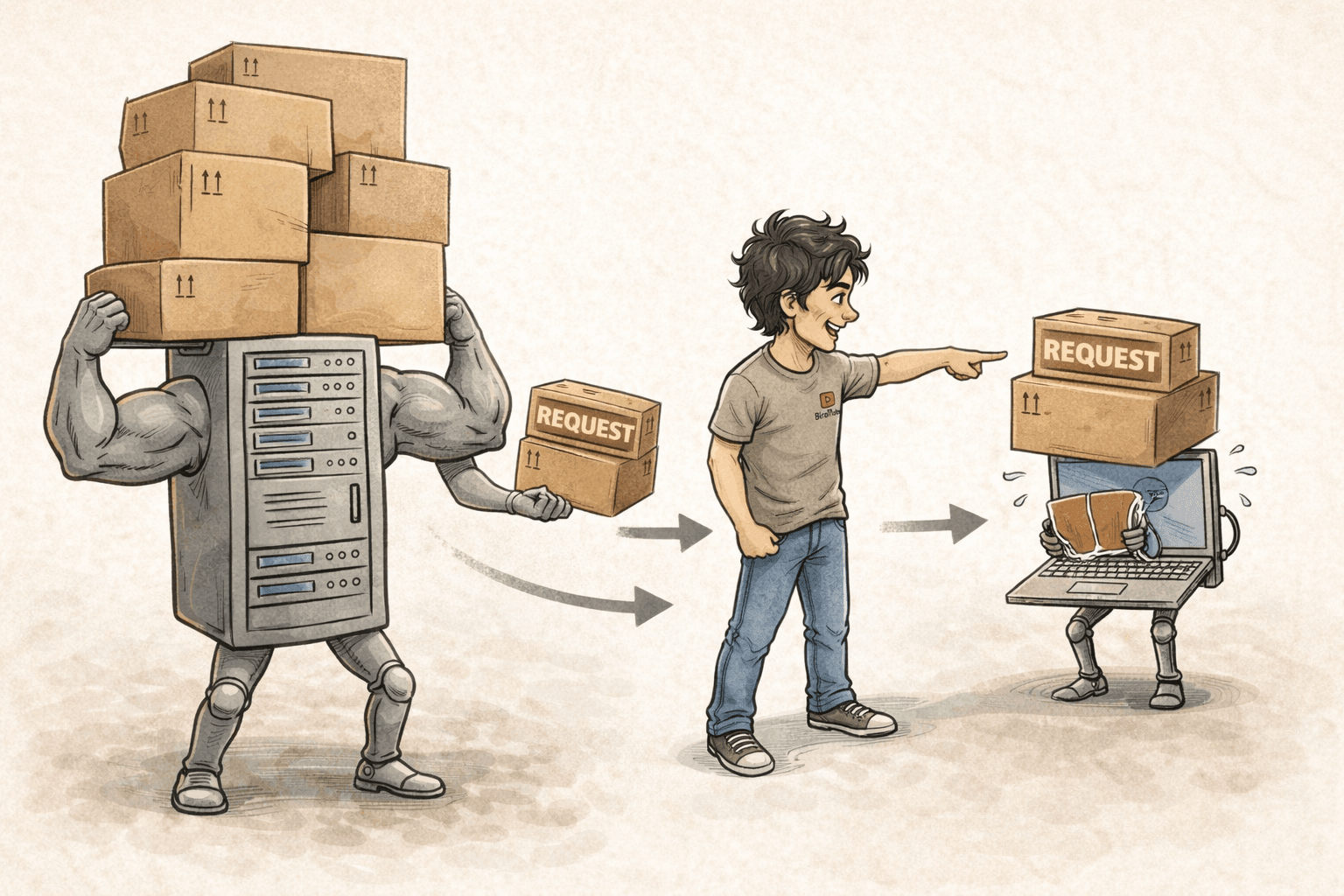
Montu suddenly remembered: "Wait! I've got one shiny new monster PC and one creaky old laptop. If I run plain Round Robin, my powerful machine is wasted!"
That's exactly what Weighted Round Robin fixes. Here you get to tell it how strong each server is.
- Monster PC (Weight 5) -> hand it 5 requests at a time.
- Laptop (Weight 1) -> hand it 1 request.
Work gets divided by muscle.
Least Connections
The supermarket checkout 🏦
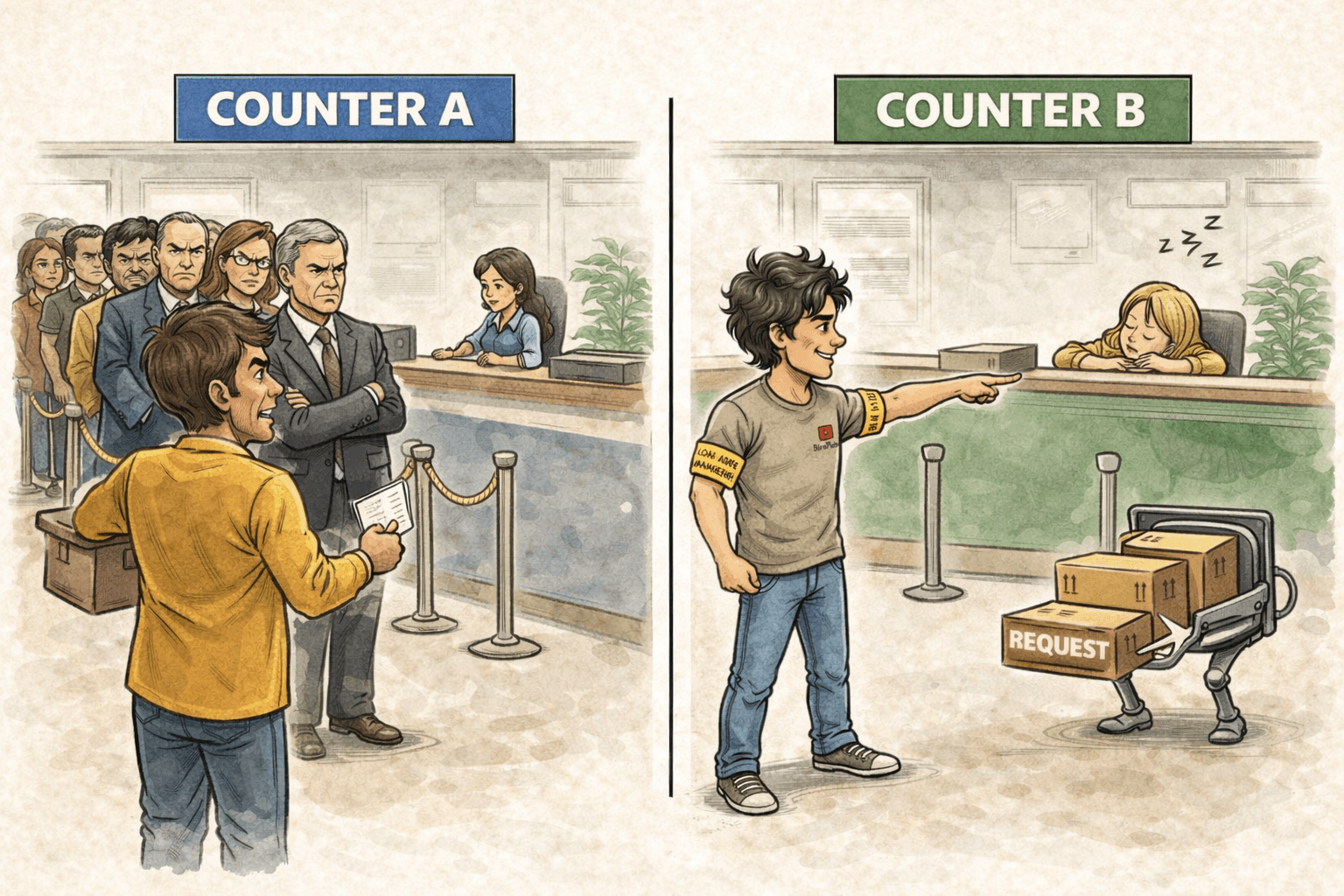
This one's a bit smarter. Say you're at the bank or the supermarket. There are 5 counters open. Which line do you join? The shortest one, obviously.
Least Connections does exactly that. The load balancer keeps an eye on how many requests each server is currently chewing on. When a new request arrives, it finds the most relaxed server (fewest active connections) and sends it there.
When to use it?
When requests take wildly different amounts of time. One user is uploading a video (slow), another is just sending chat messages (quick). For cases like that, Least Connections shines.
IP Hash
Your usual driver, your usual barber 🛺
Sometimes you just won't let anyone but your usual barber touch your hair. Why? Because they know you, they know exactly how you like it.
Software has the same need sometimes. Say a user named Karim logs in, and his session (or shopping cart) lives on the server he first landed on. Next time he sends a request, you want him sent back to that same server, not a random new one.
The IP Hash algorithm runs the user's IP address through a calculation (a hash) to pick a server. It doesn't need to remember anyone: the same IP always gives the same answer, so the user lands on the same specific server every time. Sending the same user back to the same server like this is called a 'Sticky Session'. IP Hash is just one way to get it; another common way is a cookie that remembers which server the user belongs to.
📝 Montu's quick note - filing away the rest:
Montu spotted a few more algorithm names in the book. He didn't read every detail, but he scribbled down what each one does in a line:
- Least Response Time: kind of like a quiz show, fastest buzzer wins. Whichever server answers first (TTFB) gets the new work. Speed is everything here.
- Least Bandwidth: picks whichever server is currently pushing the least data (traffic in Mbps).
- Random: no thinking at all! Eyes closed, lottery-style, send the user to any server. If you're lucky, they land on a fast one. If not, they get the slow one. 🎲
- Custom: when none of the rules above scratch the itch, engineers write their own (for example: only premium users get the fast servers).